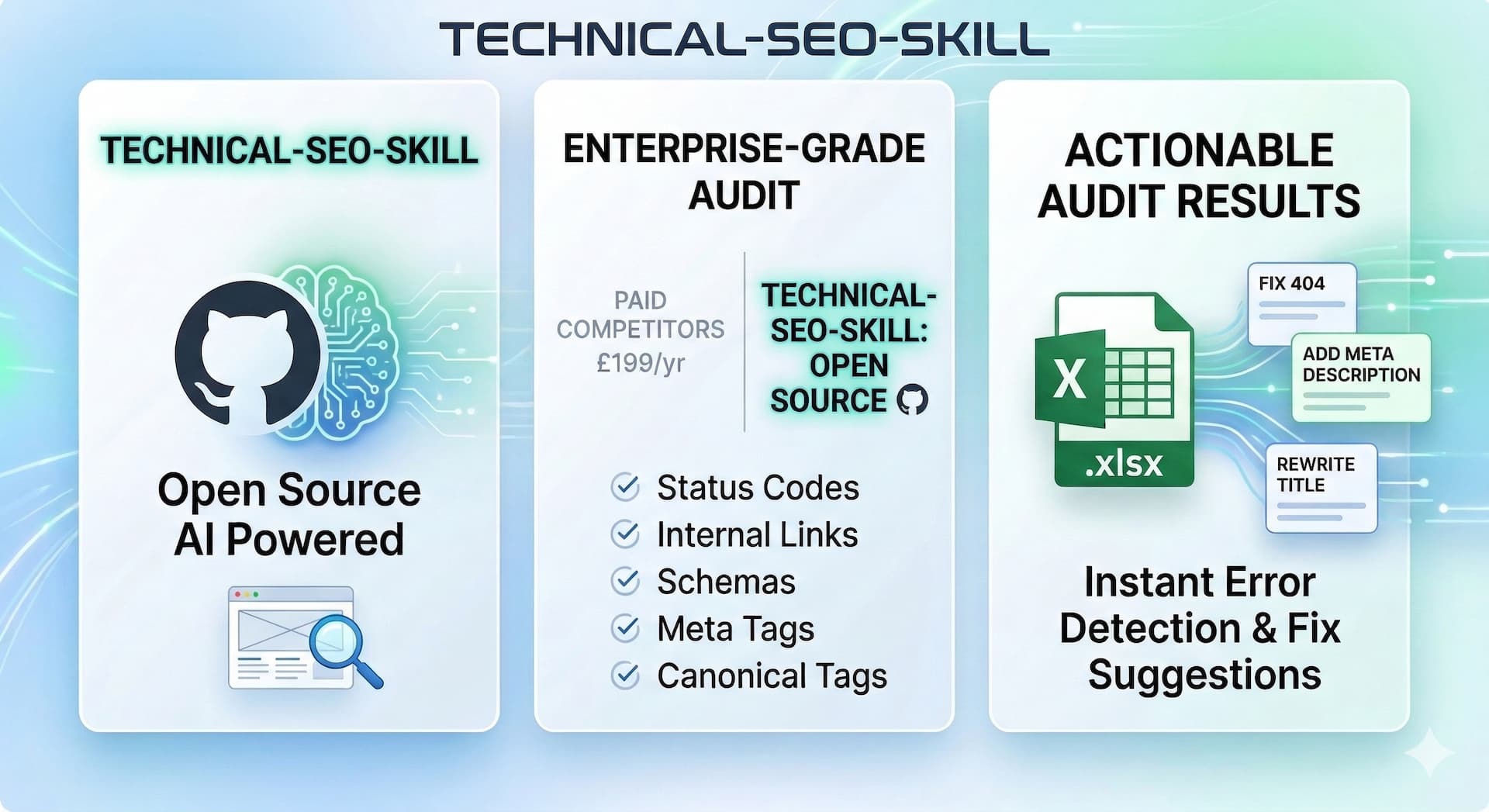
See what a serious technical SEO audit actually looks like before you buy one
Everyone says they can grow traffic. Everyone says they can identify technical issues. But very few people show the actual quality of the thing that matters most: the report that is supposed to reveal what is broken, explain why it matters, and guide the work that follows.
That is the gap this page is meant to close.
This sample technical SEO report exists so you can evaluate the real depth, structure, and clarity of a technical audit before you commit to one. Instead of asking you to trust generic promises, this page gives you a practical benchmark. You can see what a real audit deliverable should look like, how issues should be organized, how technical problems should be prioritized, and how the final output should help a team move from diagnosis to execution.
A proper technical SEO report is not a random export from a crawler. It is not a vague slide deck. It is not a long spreadsheet full of disconnected issues with no clear next step. A good report should behave like a technical SEO operator: it should discover, validate, classify, prioritize, and guide action. That is what this sample is designed to demonstrate.
Why a sample report matters more than a sales pitch
Most SEO buyers do not have a visibility problem. They have an evaluation problem.
They do not know how to tell the difference between a shallow audit and a high-quality one until after they have already paid for the work. That is why so many companies end up with technical SEO deliverables that are either too basic, too noisy, or too abstract to be useful.
The reason is simple. Technical SEO sounds complex enough that many providers can hide behind terminology. It is easy to talk about crawlability, canonicals, orphan pages, structured data, Core Web Vitals, duplicate metadata, text-to-code ratio, internal linking, and image optimization. It is much harder to package those findings into a report that helps people make decisions.
A sample report removes that ambiguity.
It allows you to evaluate:
– how the audit is structured
– how deeply the site is inspected
– how clearly issues are categorized
– whether the report separates noise from real SEO signals
– whether the output is useful for developers, marketers, and decision-makers
– whether the audit creates a practical action path rather than just an issue dump
That is why the sample matters. It reveals the quality of the process behind the service.
What this report is designed to solve
A serious technical SEO report is supposed to solve a business problem, not just produce a technical artifact.
The problem usually looks like this:
Your website has grown over time.
More templates were added.
More pages were published.
More images were uploaded.
More internal links were created.
More sections, subfolders, and sometimes subdomains were introduced.
Different teams touched different parts of the site.
Technical decisions were made in phases, not all at once.
Over time, that creates hidden structural debt.
Pages become too deep.
Important URLs lose internal prominence.
Duplicate or weak metadata appears at scale.
Canonicals are missing or inconsistent.
Broken internal links accumulate.
Image payloads become heavier.
Thin pages expand quietly.
Schema becomes partial.
Utility URLs and wrappers start polluting the crawl.
On the surface, the site may still look fine.
Under the hood, organic performance becomes less efficient.
That is what a good technical SEO audit is meant to solve. It brings structure back to a site that has accumulated invisible complexity.
What a high-quality technical SEO audit should include
A proper technical SEO report should be broader than a metadata check and more disciplined than a raw crawl export.
It should cover the site from multiple angles, including:
Site-level technical access and discovery
The report should verify whether foundational discovery files exist and whether they are usable. This includes `robots.txt`, `llms.txt`, sitemap discovery, and other structural signals that affect how search engines and AI systems understand the site.
URL-level technical and on-page quality
The report should inspect page titles, meta descriptions, H1 usage, heading hierarchy, canonical implementation, hreflang signals, and other page-level elements that influence search understanding and snippet quality.
Internal architecture and crawl logic
A strong report should identify pages that are too deep in the internal link graph, pages that are effectively orphaned, and internal links that are broken or pointing to low-value targets. This is one of the most important areas because poor internal architecture quietly weakens SEO over time.
Content and quality signals
Pages that are technically accessible but structurally weak still create SEO drag. Thin pages, low text-to-HTML ratio, and low-information templates should be visible in the audit, especially when they appear at scale.
Media and image SEO
An effective report should not stop at URL issues. Images matter too. Oversized files, missing alt text, missing dimensions, outdated formats, and broken internal images all affect performance and quality. A mature technical SEO process audits media as a first-class layer.
Structured data review
Schema should not be treated as a yes-or-no checkbox. A good report should show where structured data is present, what types are being detected, and provide enough sample output for a reviewer to understand how it is implemented.
Action layer
A proper audit should not end at observation. It should generate tasks that can be assigned, discussed, and prioritized. If the report cannot help execution, it is incomplete.
What makes this sample report stronger than a generic crawler export
One of the biggest misunderstandings in technical SEO is the belief that a crawl by itself is the audit.
It is not.
A crawler gives you raw material. The audit is the interpretation.
Raw crawls frequently over-report meaningless noise:
– parameter variants
– login wrappers
– share states
– utility pages
– search states
– system routes
– pages that should not be treated as strategic SEO URLs
If a report does not control for these patterns, the output becomes inflated and hard to trust. It can look “big” while being strategically weak.
This sample report is designed around a more disciplined logic:
– noisy parameter patterns are normalized
– auth wrappers are isolated instead of polluting the main issue set
– broken internal links are validated instead of assumed
– orphan page analysis is based on crawl graph logic
– images are audited separately from URLs
– schema is summarized and sampled in a reviewable format
– the task list is tied to real issue types, not a blind export
That difference matters more than most buyers realize.
When a report handles scope cleanly, the findings become more credible.
When the findings become more credible, prioritization becomes easier.
When prioritization becomes easier, execution becomes faster.
Who this sample report is most useful for
This sample report is useful for several different types of stakeholders.
Founders and business owners
If you want to understand whether technical SEO debt may be limiting organic growth, this kind of report gives you a clearer picture than generic SEO commentary. It shows where hidden structural issues may be hurting efficiency, discoverability, and scalability.
Marketing leaders
If you need an audit that can be shared with developers, content teams, and leadership without becoming vague or bloated, the structure of the report matters as much as the findings themselves. A report should help teams align, not create more confusion.
In-house SEO teams
If you are already running SEO internally, this sample can help you benchmark reporting quality. It shows how a crawl can be converted into a usable workbook rather than remaining a pile of exports and ad hoc notes.
Agencies and consultants
If you provide technical SEO services, this sample can also serve as a benchmark for how structured and execution-ready your own deliverables are. It shows what happens when the reporting layer is treated as part of the product, not as an afterthought.
Complex websites
This kind of reporting becomes especially valuable when a website has:
– multiple page templates
– large content archives
– multiple language or regional segments
– relevant subdomains
– heavy image usage
– editorial + commercial sections
– growth-stage technical debt
The more complexity a site has, the more damaging low-quality reporting becomes.
Why reporting quality directly affects SEO outcomes
Many websites do not struggle because no one knows what technical SEO is. They struggle because the technical work is not translated into an operating document that teams can actually use.
That happens in several ways.
The audit may identify too many issues without enough prioritization.
It may separate diagnosis from execution.
It may list issues page by page without showing patterns.
It may classify low-value URLs as important assets.
It may fail to explain why one issue matters more than another.
It may overwhelm the team instead of guiding them.
All of those reporting failures create operational drag.
And operational drag is one of the biggest hidden reasons technical SEO work stalls.
A good report reduces that drag.
It gives leadership a concise overview.
It gives specialists detail where needed.
It gives developers cleaner tickets.
It gives SEO teams a rational order of execution.
It gives the business a more actionable understanding of technical debt.
That is why reporting quality is not cosmetic. It is part of the performance system.
What the best technical SEO reports do differently
The strongest technical SEO reports share a few traits.
They do not confuse completeness with usefulness.
They do not simply collect data. They classify it.
They do not present all findings at the same importance level.
They create a practical hierarchy of issues.
They do not rely on a single view of the site.
They combine sitemap logic, crawl paths, page-level analysis, link validation, and asset review.
They do not assume the reader is a technical SEO specialist.
They are readable for decision-makers and detailed enough for implementers.
They do not stop at “what is wrong.”
They answer “what should happen next.”
That is the standard this sample report is built around.
What you should look for when reviewing the sample
As you review the sample report, focus on the following questions:
Is the issue overview clear without being shallow?
Can you quickly understand what the biggest technical problems are?
Can you move from the summary into deeper sheets without losing context?
Are broken internal links and orphaned pages clearly isolated?
Does the report help distinguish URL issues from image issues?
Does the schema section provide enough visibility to understand implementation quality?
Do the tasks feel like real next steps rather than generic filler?
Does the overall structure feel like something your team could actually use in a real SEO workflow?
If the answer to those questions is yes, the report is doing its job.
Why this matters before you request your own audit
A sample report gives you more confidence than a capability claim ever can.
Instead of asking whether a provider understands technical SEO, you can judge whether they understand technical SEO operations. That is a much more useful standard.
The difference between a weak and strong technical SEO audit is not just whether issues are found. The difference is whether the output helps people make better decisions and move faster.
That is what this page is meant to show.
It is not just a sample file.
It is a benchmark for what a serious technical SEO deliverable should look like.
Review the sample report
If you want to understand what a real technical SEO workbook looks like before requesting one, review the sample report and use it as your benchmark.
A serious audit should be:
clear enough for leadership,
detailed enough for specialists,
structured enough for execution,
and strong enough to surface real technical debt without drowning the team in noise.
Need a technical SEO audit for your own site?
If this sample reflects the level of depth, structure, and clarity you want for your own website, the next step is straightforward.
Request a technical SEO audit built around your real site architecture, your templates, your subdomains, your internal linking structure, your image inventory, and your growth priorities.
Whether your main issues involve crawl efficiency, weak internal linking, canonical inconsistency, metadata duplication, media bloat, structural debt, or indexation quality, the objective is the same:
identify what matters,
prioritize it properly,
and turn it into a clean, execution-ready roadmap.
If that is the kind of technical SEO work you want, use this sample as the standard.


